
Harmon County Release Records
A person leaves Harmon County Jail in one of several ways. Bond, recognizance, time served, sentence completion, or an authorized court disposition can end physical county custody. Probation may place a person in the community under conditions. A transfer is different. Harmon County Sheriff's deputies may move a sentenced person to an Oklahoma prison, and another agency may take custody on a warrant, writ, or detainer. The person then disappears from the Harmon County roster without becoming free in the community.
The official Harmon County inmate search describes itself as an in-custody search. It gives booking information, charges, added information, a name tool, and an image area when one is available. It does not advertise a released filter or archive. After a name drops off, the Sheriff's release entry, VINE event, court record, or receiving agency record must supply the next fact. The source should always be named because a discharge from one custodian does not end every case, sentence, hold, or supervision term.
- Discharge
- Departure from a named custodian, or in some records the end of a correctional obligation. The surrounding fields control the meaning.
- Transfer
- Movement to another custodian while confinement continues.
- Time served
- Local confinement credited as satisfying the ordered jail term, subject to other holds.
- Detainer
- A request or legal basis for another authority to assume or keep custody.
How Harmon County Custody Ends
The event label changes both the legal meaning and the next search. Bonded release means physical jail custody ended while the case can continue. Dismissal or declined charges may explain a release, but the docket must confirm that legal outcome. Parole is conditional community release from an ODOC sentence. Probation is community supervision tied to a court sentence and may occur without a state-prison release. An escape or absconding event is not a lawful discharge and must never be grouped with released inmates.
| Custody event | What it means | Best next record |
|---|---|---|
| Bond or recognizance | County custody ended while the case remains active. | Sheriff release entry and court docket |
| Time served or sentence complete | The ordered local confinement ended, unless another hold applies. | Jail register and judgment |
| Probation or parole | The person is in the community but may remain under legal supervision. | ODOC status and supervision office |
| State-prison transfer | The person left the county jail but stayed incarcerated. | ODOC Offender Lookup after intake |
| Other-agency handoff | Another county, federal, tribal, or immigration authority took custody. | Receiving agency record |
A court order and a physical exit are not the same record. The docket can show the authority for bond, dismissal, or sentence. The jail register shows the actual discharge or transfer time and authority. Pairing those two layers avoids treating a planned event as a completed release.
Harmon County Release Record Fields
Oklahoma law makes the jail register the strongest local retrospective source. Under 51 O.S. §24A.8, public jail-register facts include who was received, why and under whose authority, and how custody ended. A focused request can also ask for the booking sheet, custody-disposition entry, public bond details, charges at release, destination, and booking photograph. Some requested material may be redacted or withheld under a separate rule.
| Field | What it establishes |
|---|---|
| Name and booking identifier | Connects the release event to the correct booking episode. |
| Receipt date and time | Shows when the jail received the person. |
| Commitment reason and authority | Names the basis and source of county custody. |
| Discharge or transfer date and time | Records when custody by Harmon County ended. |
| Discharge or transfer authority | Distinguishes a community exit from a custodial handoff. |
| Bond amount and recipient | Documents public bond facts when applicable. |
| Fees or expenses in the register | Shows the statutory register's listed financial entries. |
The official statute display provides the source context for these fields. The Oklahoma jail-register provision is shown below as captured from the linked statutory source.
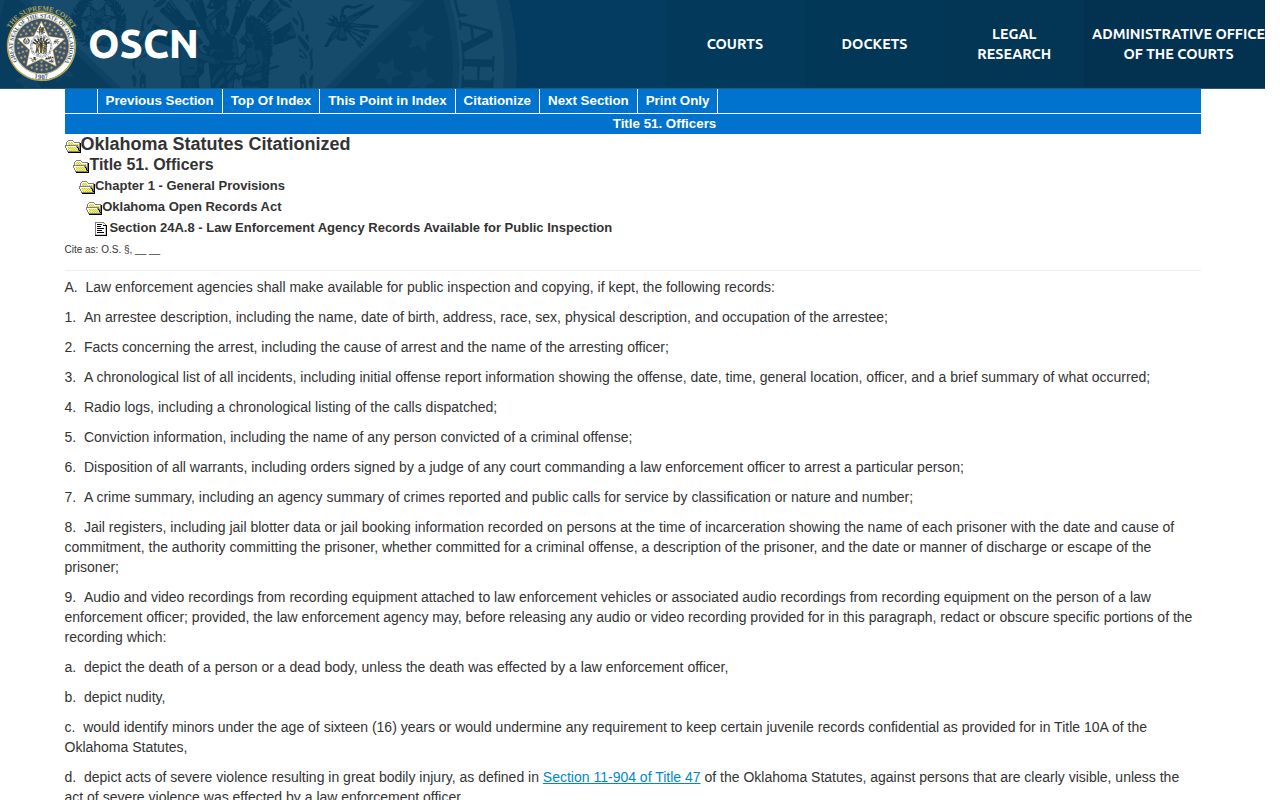
Those fields answer a question that the current roster cannot: whether the Harmon County exit was a discharge or a transfer, and which authority approved it.
Request Harmon County Release Records
The Sheriff's online Records Division form is the direct local request route. Ask for one named booking episode or a narrow date range. Give the full name and, when known, a date of birth, booking number, case number, or approximate booking date. Ask for existing records rather than asking staff to create a narrative. Electronic copies can reduce copying and delivery issues.
- Identify the person and bounded booking or date range.
- Request the jail-register entry, booking sheet, release or transfer entry, and receiving agency when recorded.
- Ask separately for the booking photograph and any public bond or charge fields needed.
- Request notice before fees are incurred and ask for the legal basis of any withheld part.
- Keep the response, source, access date, and record identifiers together.
The Sheriff posts a $38 hourly rate for report or video redaction labor, billed in 15-minute units, but does not say every release record costs that amount. Applicants are told that applicable charges will be communicated and not to prepay. Oklahoma's general open-record access provision addresses prompt, reasonable access, inspection, copy limits, and defined search-fee conditions. A narrow request lets Records give a useful estimate without mixing copying, search, and redaction costs.
Harmon County Sheriff's Office and Jail105 W. Jones
Hollis, OK 73550
(580) 688-3306
Administration: Monday through Friday, 8:30 a.m. to 4:30 p.m.
Dispatch: 24 hours
Dispatch availability does not mean routine records work is performed at all hours. The Sheriff's pages state no fixed response period or online post-release retention window. If an old record is unavailable, ask which retention schedule applies and whether a disposition date exists.
Harmon County Bond Release Delays
The Sheriff's registered bondsmen page adds a local warning to the release process. A bond that is completed or notarized incorrectly will not be accepted by the court clerk. Once a case has been filed, the case number is also required. Those details can delay a planned bond-out even when arrangements have begun.
Bond paperwork is not proof that the person walked out. The court record can show the bond or order, while the jail-register discharge time confirms the county custody event. A person may also face a second hold. Check the final release authority before telling family that a proposed bond resulted in community release.
Note: A bond ends physical custody only after processing; it does not dismiss the Harmon County criminal case.
Harmon County Release Record Access
Public access has limits. Juvenile material, sealed or expunged records, medical information, victim data, security-sensitive material, and protected personal details may receive separate treatment. Oklahoma expungement under 22 O.S. §§18 and 19 depends on the case result, offense, record, sentence completion, exclusions, and timing. There is no sound universal waiting period. A deferred-sentence process, a full expungement, and a pardon are different legal events.
A sealing order can remove covered material from ordinary public view. That explains why a later search may return nothing, but it does not let a reader infer the past one way or the other. For a legal use or correction, obtain the actual clerk or agency response. Online court summaries can be short, and agency copies may update on a different schedule.
Find Harmon County Released Inmates
Start with the last known custodian. The Harmon County roster is an exclusion check for present local custody, not a historic release search. Its own instructions point to VINE when a person may have been released or transferred. A missing name creates several live possibilities: release, transfer, intake lag, spelling mismatch, another facility, or an update problem.
- Search the Sheriff roster by name. A current match means the site still reports county custody.
- If absent, note the check time and search the specific person in Oklahoma VINE. Preserve the displayed event wording.
- Check ODOC in case Harmon deputies transferred a sentenced person into state custody.
- Search Harmon County in ODCR and OSCN for the legal event behind the custody change.
- Use BOP, ICE, or the relevant receiving system only when that custody path applies.
- Request the Sheriff jail-register entry for the exact time, type, authority, and destination.
The county does not publish a separate recent-release feed. Readers seeking a defined same-day window can use the Harmon County 24-Hour Releases request workflow, while a named-person inquiry should keep following every applicable custodian.
ODOC Harmon County Release Search
ODOC Offender Lookup covers people who entered the Oklahoma corrections system. It is not a mirror of the county jail. Use an ODOC number when available, or search by the supported name and identity fields, compare the match, and open the individual record. Read custody, facility, sentence, supervision, and date labels exactly as displayed. A community-supervision status means prison confinement ended while legal supervision can continue. An inactive or discharged record is different.
| Search detail | How to use it |
|---|---|
| ODOC number | Use the stable agency identifier when known. |
| First and last name | Try exact and supported partial or similar-sounding options. |
| Date of birth and aliases | Compare identity details before opening a namesake record. |
| Status and location | Separate incarceration, community supervision, and discharge. |
| Sentence and date labels | Preserve the current label and do not turn an estimate into a promise. |
The ODOC offender-information page explains the lookup and warns that public data are abbreviated. Its captured view appears below.
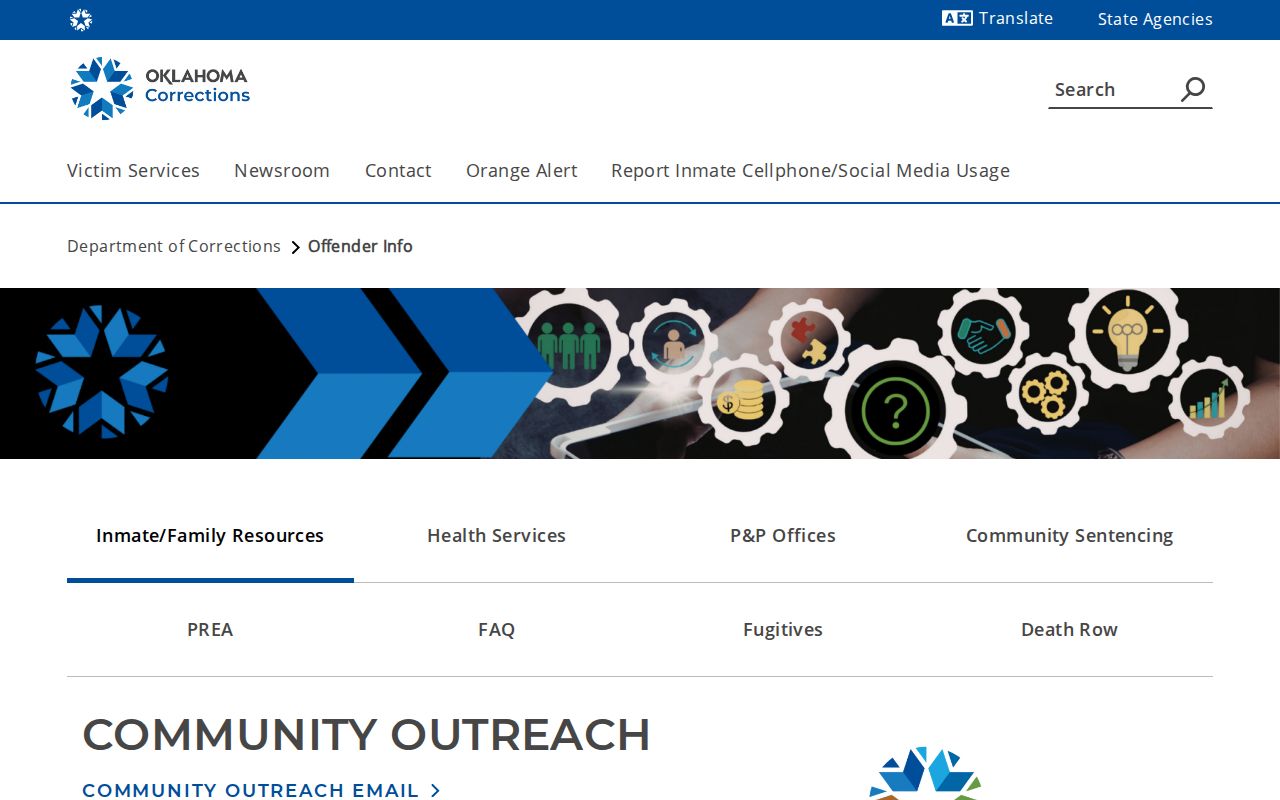
A local bond release may never create an ODOC record. Use ODOC only when state commitment or supervision is plausible.
Harmon County Release Court Records
ODCR expressly lists Harmon County in its Oklahoma District Courts selector. Search the last-name, first-name format, choose Harmon and an appropriate criminal case type, then verify the party and case number. OSCN docket search is a second route, though it may require human verification. Bond approval, dismissal, judgment, sentence, warrant recall, and completion entries can explain why a custody event occurred.
The court docket is durable legal context, not a jail clock. It generally will not supply the moment a person physically exited. A prison commitment can instead explain transfer to ODOC. For a certified document, contact the Harmon County Court Clerk. The ODCR selector captured from the official route shows the county-specific entry point.
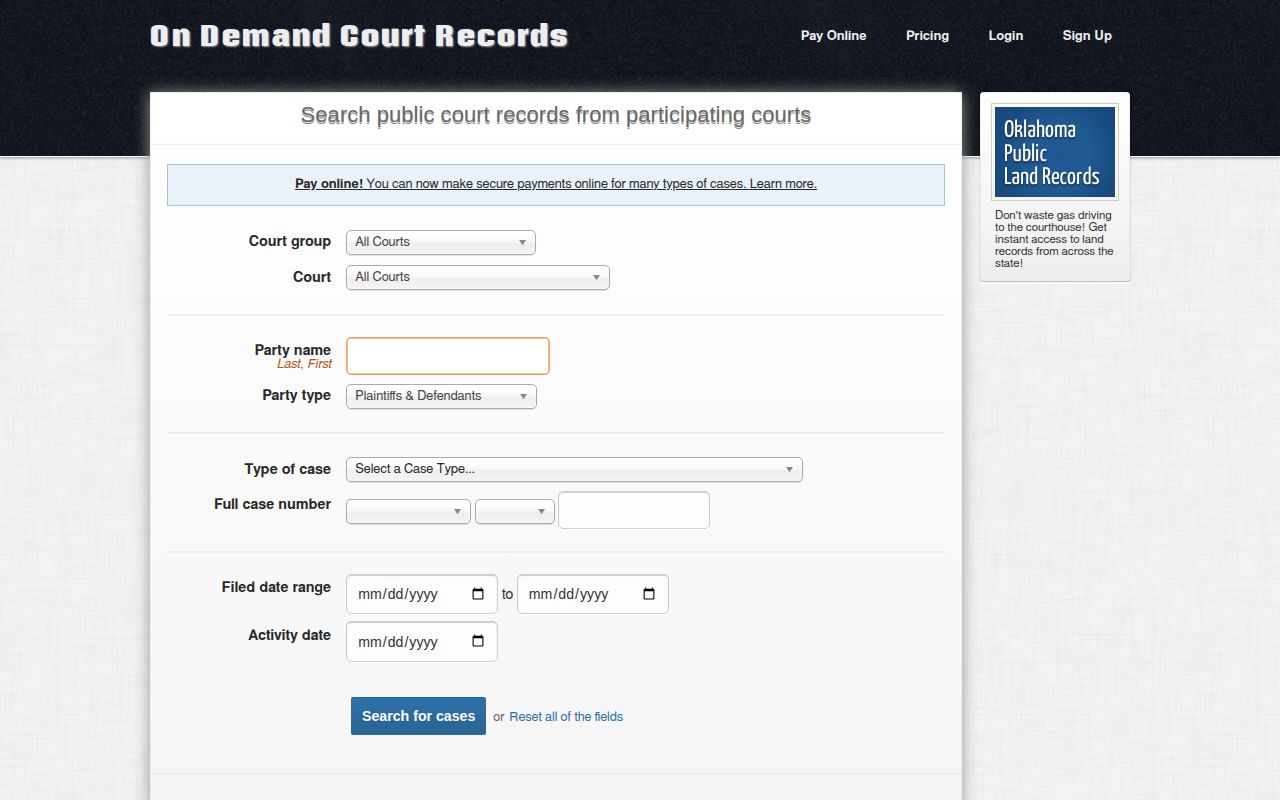
Pair the selected case with the Sheriff's discharge or transfer entry to connect legal authority with actual movement.
The official OSCN docket search supplies the complementary statewide court route shown below.
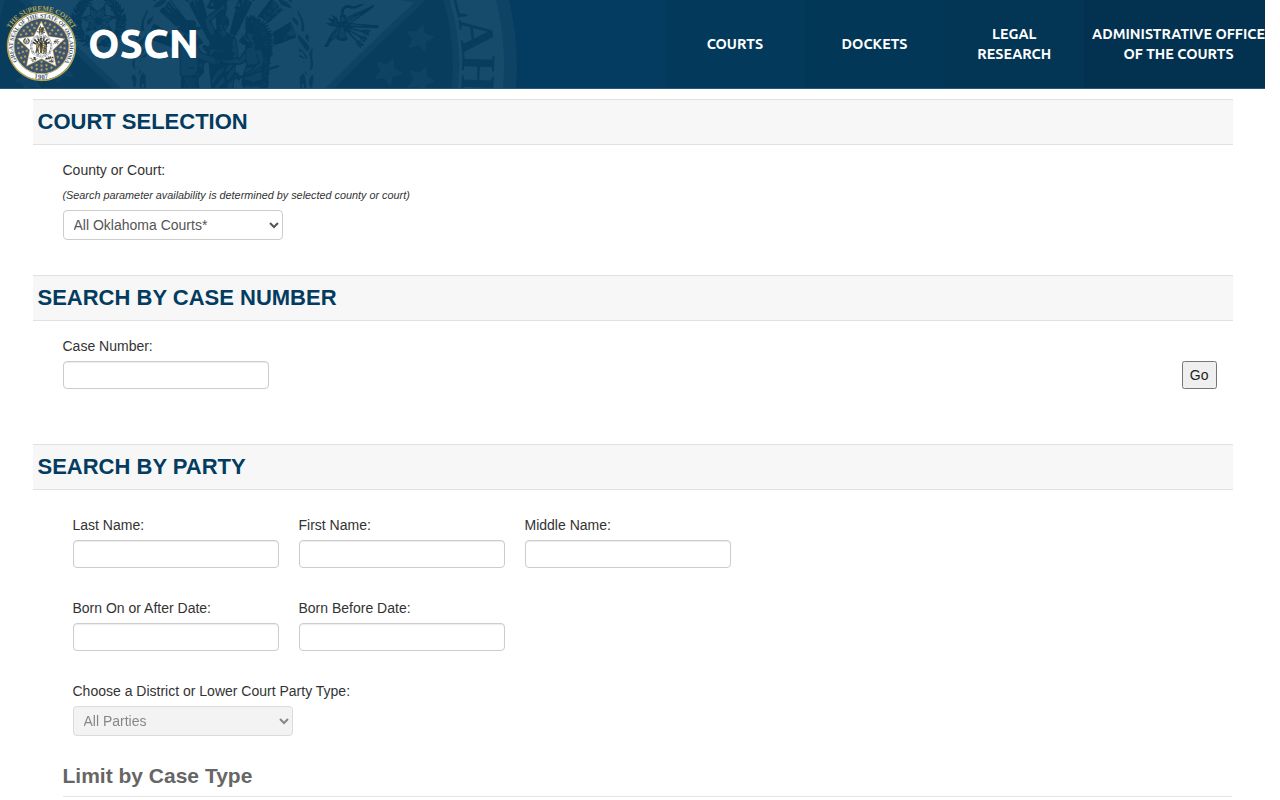
Human verification or a blank screen is an access issue, not proof that no Harmon County case exists.
Harmon County Release Supervision
The Oklahoma Pardon and Parole Board handles parole decisions. ODOC Probation and Parole Services handles field supervision. A favorable board result may explain a future conditional release, but it is not a jail-door timestamp. ODOC status and the later custody event show whether the release was carried out. Probation can also follow a suspended sentence without any state-prison stay.
Harmon County is routed to the Altus Probation and Parole Office. A person can be out of the institution yet remain under ODOC supervision. Terms such as parole, probation, inactive, terminated, and discharged should not be exchanged. Harmon County post-release supervision records connect the Altus route, board results, ODOC status, and official fugitive check.
IDs After Harmon County Release
ODOC's reentry information includes an identification section and routes to Oklahoma birth-certificate and other document resources. That channel can help someone rebuild personal records after state custody. It does not correct a county booking record, court docket, or ODOC offender record.
Send a correction to the agency that created the entry. Harmon County Sheriff controls the jail movement record. The court clerk controls the docket. ODOC controls its offender and sentence data. Keeping those owners separate prevents an identity-document request from being mistaken for a release-record correction.
Harmon County Release Notifications
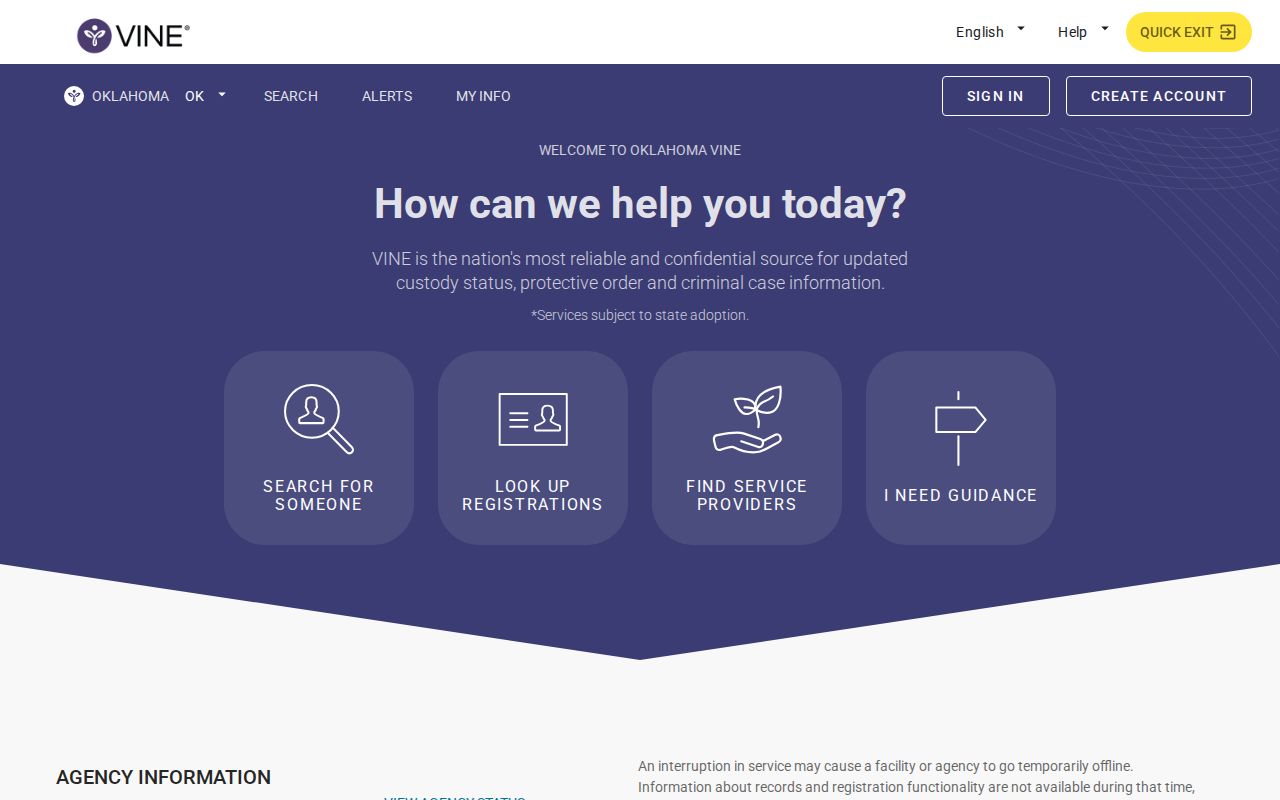
Oklahoma VINELink is the Sheriff's named next check after a roster miss. Search one person, compare the displayed identifiers and feeding agency, and read the custody status or event literally. A transfer alert means transfer. A no-result can reflect a name issue, lag, coverage, or retention and does not prove release. Alerts may be registered for the offered phone, text, email, or in-app channel. Exact release facts should still be checked against the Sheriff or ODOC record.
The Oklahoma VINE entry screen shown below reflects the state route documented by the Sheriff.
Federal cases require a different tool. The BOP locator can retain a federal release date and status for sentenced federal prisoners, as the official search view below illustrates.
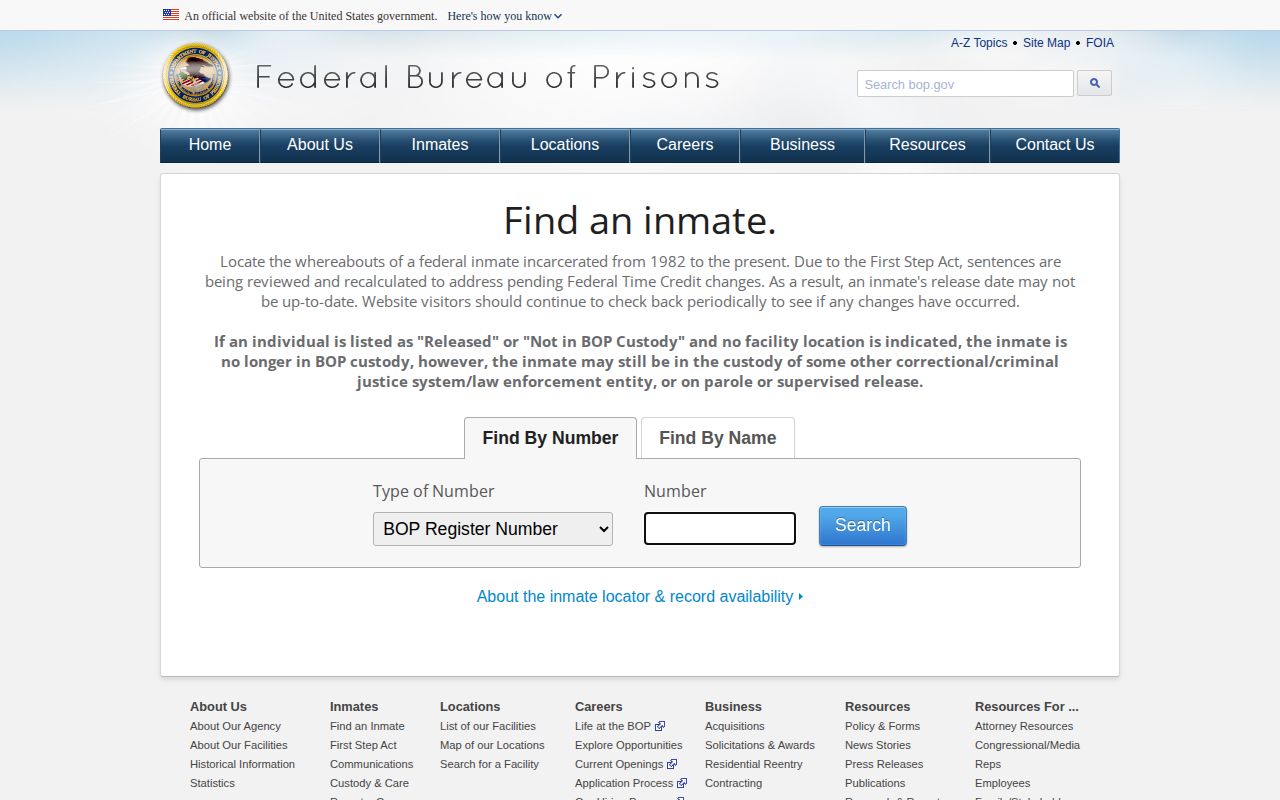
A BOP result concerns federal custody only. ICE's detainee locator is current-focused, so disappearance is not historic release proof. USMS pretrial custody may require a federal docket and the relevant district route. Each result proves only what happened in that named system.
Harmon County Transfer Records
The Sheriff's Transport Division page confirms that county deputies move people from the detention center to Oklahoma state prisons after sentencing or the required process. Oklahoma's jail-register law separately requires the record to distinguish discharge from transfer and identify the authority. Together, these local facts explain the most important Harmon County search trap.
The official transport page is captured below for context.
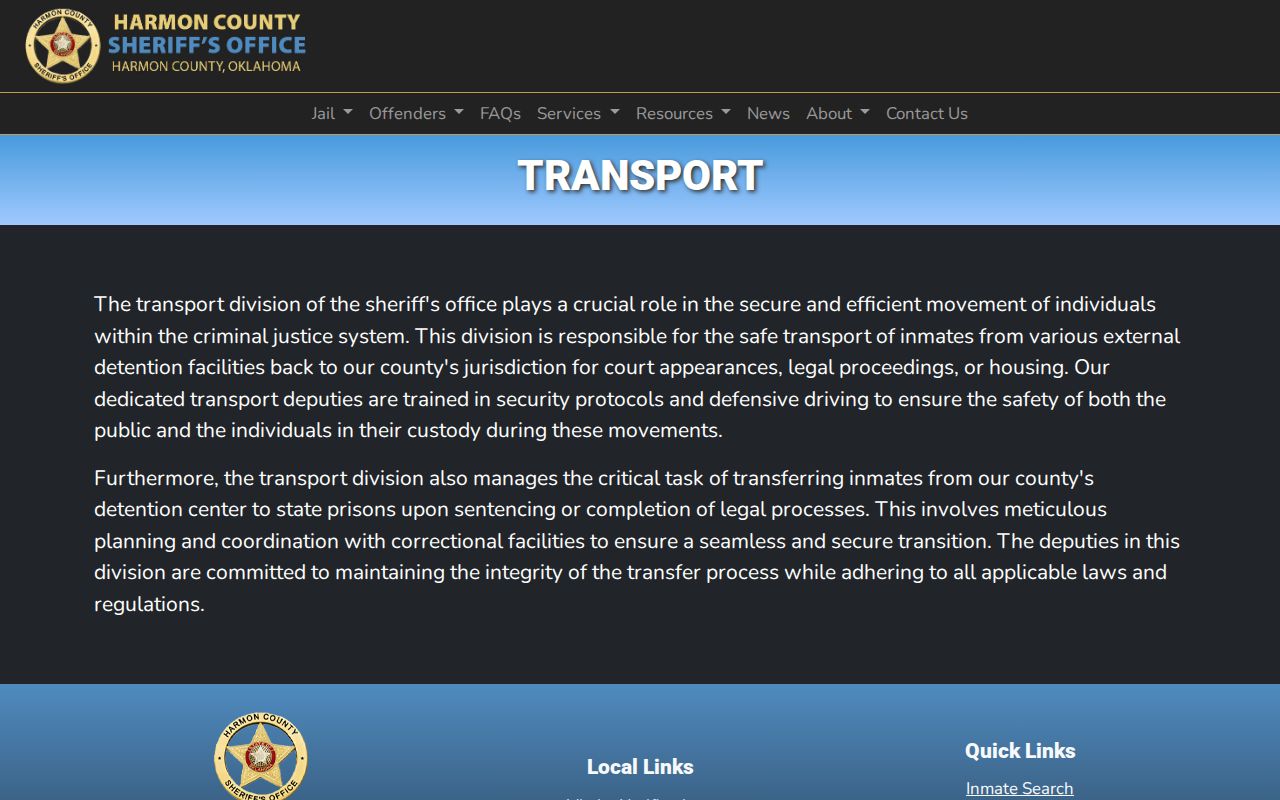
A person who moves into ODOC may vanish from the local roster before the state intake record appears. Recheck both systems and preserve access times. When the destination matters, request the receiving agency field from Sheriff Records rather than calling the movement a community release.
Compare Harmon County Release Sources
Each official source answers a narrow question. Using the correct one keeps still-in-custody, released, supervised, and transferred people from being grouped together.
| Source | What it can show | What it cannot prove alone |
|---|---|---|
| Harmon County roster | Current reported local custody and booking details | A missing person's release, time, reason, or destination |
| Sheriff jail register | Actual local discharge or transfer time and authority | Every later court or supervision event |
| VINE | Participating custodian status, event, and notifications | A certified historic release record |
| ODOC lookup | State commitment, custody, supervision, or discharge posture | A purely local bond release |
| ODCR or OSCN | Case orders, bond, disposition, and sentence context | The exact physical jail exit time |
| BOP or ICE | Custody information within the named federal system | Freedom from all other jurisdictions |
Question: Does a blank roster confirm release?
No. It confirms only that the name was not displayed in the current Harmon County search at that check. VINE, ODOC, the docket, and the jail register resolve the reason.
Harmon County Release Facility
Official sources support one current local detention operation in Harmon County. The Harmon County Jail is operated by the Sheriff's Office in Hollis. No current ODOC prison, federal prison, ICE detention center, regional jail, or separate municipal detention facility was established inside the county. Historical references to a community work center are not treated as a current facility.
- Harmon County Jail: local releases may return to the community, move into ODOC, or transfer to another authority. The Sheriff's record identifies which path occurred.
Note: The jail's administrative hours do not establish a daily release schedule, release door, or family waiting location.